Air-gapped deployment. Zero cloud dependencies. Built for professional services.
Client contracts and compliance requirements demand better
Designed for firms with the highest confidentiality requirements
Deploy on your internal network with no external connectivity. All data stays within your security perimeter. No cloud services, no external APIs, no internet access required. Perfect for law firms, healthcare providers, and financial advisors.
No vendor access to your deployment. No support backdoors. No telemetry or analytics sent anywhere. Your IT team has complete control. Audit the open source code yourself to verify security claims.
Demonstrate technical controls to demanding clients. Architecture diagrams included. Data flow documentation provided. Open source allows client security teams to review code. Passes third-party security questionnaires.
Token-based access and category-aggregated reports support confidentiality. Responses retain a token reference that may link to an invitation email. Invitation method, permissions, thresholds, and feedback content affect confidentiality; it is not a guarantee against identification by database administrators.
Open source code lets your team inspect the implementation. Export and deletion tools support GDPR obligations; your organization must assess requirements, configure controls, and maintain its own compliance processes.
Configure with your internal mail server. No external email services required. All email stays within your network. Support for Exchange, Office 365 on-premises, or any SMTP server you control.
Token-based invitation links provide reviewer access; emailed invitations may associate a token with an email address
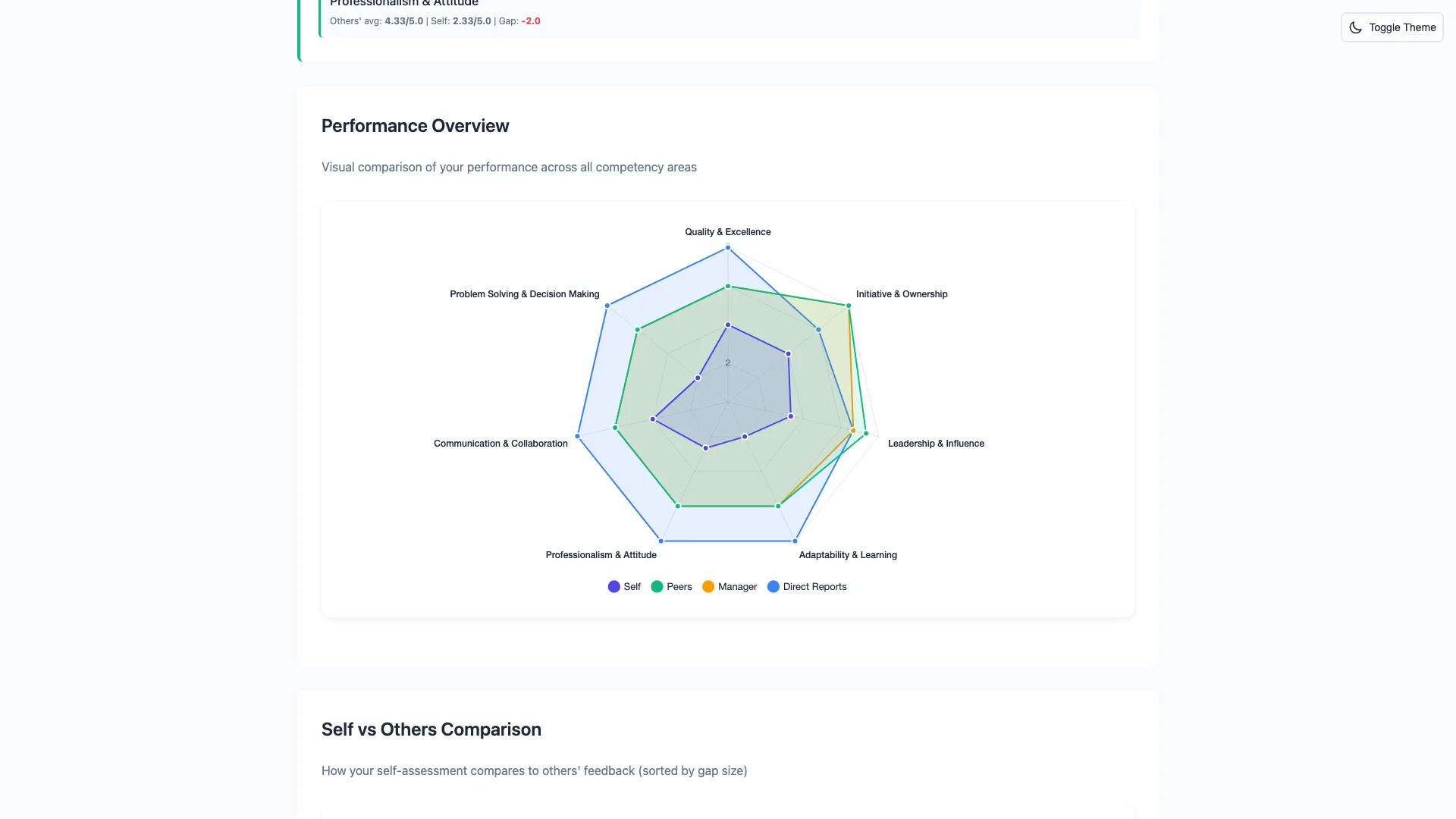
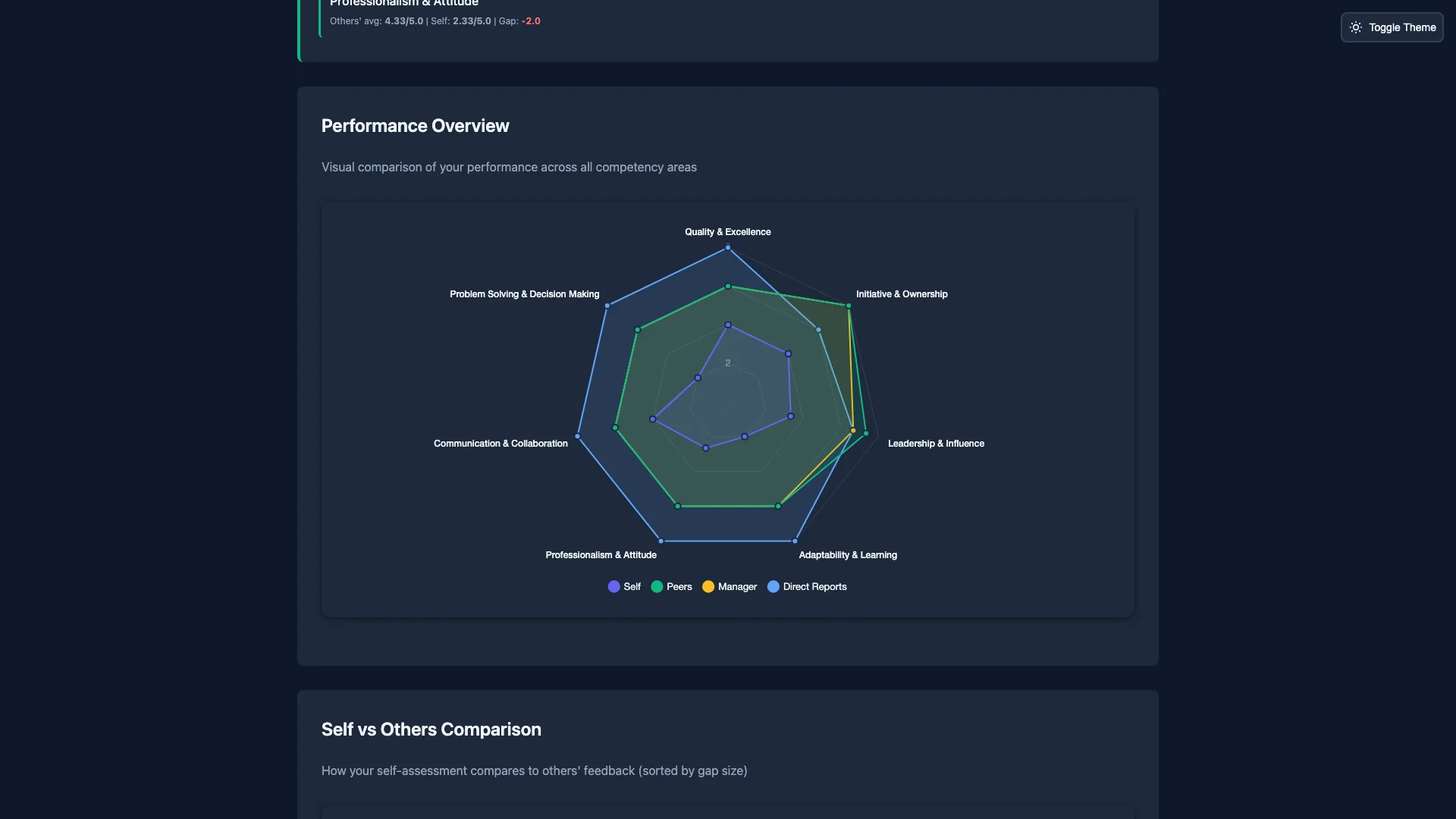
Professional reports with anonymity protection built-in
Built for teams of 30-200 employees that need control over feedback data
Assess Your Requirements: Attorney-client privilege, professional ethics, and client confidentiality depend on your firm's policies and deployment controls; self-hosting alone does not establish compliance.
Typical Setup: Air-gapped deployment behind firm firewall. Internal SMTP only. Managed by firm IT. Review cycles for attorneys, paralegals, support staff.
Assess Your Requirements: Review healthcare privacy obligations with your compliance team. Self-hosting is not a HIPAA certification or a guarantee of patient data separation.
Deployment Considerations: Limit feedback to relevant staff competencies, instruct reviewers not to include patient data, and configure access and retention for your setting.
Assess Your Requirements: Evaluate regulatory, confidentiality, access, and recordkeeping obligations before using feedback software in your firm.
Deployment Considerations: Have your compliance team assess network placement, permissions, retention, and recordkeeping requirements.
Assess Your Requirements: Your organization must manage client confidentiality agreements, conflicts of interest, access boundaries, and retention.
Typical Setup: Project-based review cycles. Partner and consultant assessments. Integration with resource management. Protected behind VPN.
Assess Your Requirements: Your organization is responsible for professional standards, client privilege, quality controls, and review documentation.
Typical Setup: Separate staff and partner reviews, technical competency assessments, and annual review cycles aligned with promotion timelines. Maintain your own supporting documentation.
Assess Your Requirements: Self-hosting does not establish ITAR/EAR compliance, FedRAMP authorization, or suitability for classified information.
Deployment Review: Obtain approval from your security and compliance teams before selecting a network or handling sensitive information.
Three deployment modes to match your security requirements
Setup: Internal server, no internet access, manual report generation
Best For: Law firms, defense contractors, highly regulated industries
Features: Complete isolation, no external dependencies, passes strictest client audits
Setup: Internal server with restricted outbound access for email
Best For: Healthcare, financial services, mid-size professional firms
Features: Controlled external access, email invitations work
Setup: Cloud server accessible only via firm VPN
Best For: Consulting firms, accounting firms with remote teams
Features: Remote access for distributed teams, still fully isolated from public internet
Self-hosted infrastructure • Open source auditability • Your deployment controls • Your compliance assessment
Self-hosting does not confer certification or automatic compliance. Your organization must assess applicable requirements and implement appropriate controls.
| Compliance Standard | Blik Support | Organization Responsibilities |
|---|---|---|
| ISO 27001 | Source code available for assessment | Define and maintain your information security management system |
| SOC 2 | Source code available for assessment | Assess controls and obtain independent assurance where required |
| GDPR | Export and deletion tools | Lawful processing, access controls, retention, processor agreements, and data subject request handling |
| HIPAA | Deployment must be assessed | Determine suitability, required safeguards, and contractual obligations before use |
| FedRAMP | No authorization implied by self-hosting | Assess applicable authorization and security requirements independently |
| PCI DSS | Deployment must be assessed | Do not put payment card data in review content; assess scope and required controls |
Why spend 50,000+ EUR per year on cloud tools you cannot use?
Lattice: 8-12 EUR/user/month
Culture Amp: 10-15 EUR/user/month
15Five: 6-10 EUR/user/month
Problem: Cannot meet your client confidentiality requirements
Cost: Partner time, admin overhead
Time: 20-40 hours per review cycle
Issues: Error-prone, not anonymous, hard to aggregate
Problem: Unprofessional and time-consuming
Licensing: 0 EUR (open source)
Server: a small EU VPS (≈€10-50/month)
Time: 2 hours setup, 1 hour per cycle
Self-hosted feedback with control over deployment
Commercial Tool: 3,000 EUR/year | Manual Process: 8,000 EUR (partner time) | Blik: 1,200 EUR/year (server only) | Savings: 2,000-7,000 EUR annually
Yes. For air-gapped deployment: 1) Use internal SMTP server for emails, 2) Deploy on internal Linux server. No external connectivity required. System is fully functional offline. Perfect for classified environments or firms with zero-trust policies.
Minimum: 4GB RAM, 2 vCPU, 40GB storage for up to 100 employees.
Recommended: 8GB RAM, 4 vCPU, 100GB storage for 200+ employees with historical data.
OS: Ubuntu 22.04+ or RHEL 8+.
Database: PostgreSQL 15+ (included in Docker setup). Scales vertically as needed.
Use the public source code to assess implementation details. Your organization must document its deployment, data flows, access controls, processors, and operating procedures against client requirements. Self-hosting does not itself satisfy an audit or provide certification.
LDAP integration is on the roadmap but not currently implemented. For now, admins use Django's built-in authentication. Since reviewers never log in (token-based access), only admin accounts need management. For firms requiring LDAP, you can modify the authentication backend in the open source code or wait for the next major release.
Reviewers use token-based links, and reports aggregate feedback by category with configurable thresholds. Responses retain a token reference, which may link to an invitation email. Confidentiality depends on invitation method, permissions, thresholds, and feedback content; it is not guaranteed against administrators with database access.
PostgreSQL backup strategies: 1) pg_dump for point-in-time backups, 2) WAL archiving for continuous backup, 3) Streaming replication for high availability. Store backups on your SAN, tape, or segregated network. All backup data remains in your control. Restoration tested and documented. RTO typically under 1 hour.
Blik provides self-service deletion tools to support GDPR requests. Your organization must assess each request, handle related records and backups under its retention policy, and document the process. The tools do not automatically establish compliance.
Typical deployment timeline for firms
Activities: IT reviews documentation, Security approves architecture, Compliance maps to requirements, Partner sponsors identified
Deliverables: Deployment plan, security assessment, compliance checklist
Activities: Provision internal server, Deploy Docker containers, Configure SMTP and settings, Import employee list
Deliverables: Running system, admin access, initial testing complete
Activities: Run pilot review cycle with one department, Gather feedback, Adjust anonymity thresholds, Train administrators
Deliverables: Pilot report, user feedback, configuration refinements
Activities: Announce to full firm, Create review cycles, Send invitations, Generate reports
Deliverables: Firm-wide review complete, Reports delivered, Process documented
Includes security review, compliance approval, and pilot testing. Much faster than 8-12 week implementations for commercial tools.
Protect client confidentiality while modernizing performance reviews.
For air-gapped deployments and complete data control, our open-source version is perfect. Or if GDPR-compliant EU hosting meets your needs, try our managed option at €49/month.
View All OptionsBuilt for teams of 30-200 employees